Showing posts with label cabbage. Show all posts

Tuesday, 19 March 2019

February 2019 in pictures

February turned out to be a very strange month. We had a spell of unusually warm weather, which made it very tempting to start sowing outdoors. Bearing in mind that we had heavy snow falls in March last year, it was a temptation that was best resisted and we stuck to starting off veg seeds in modules indoors. 

The remaining cabbages were starting to form nice compact heads and there were some Brussels sprouts left. With outdoor temperatures increasing, temporarily at least, the brassicas and kales all started to bolt, and some even began to form seed heads. So there won't be any more solid heads of cabbage from the current plants. Looking on the bright side, though, we do have a steady supply of spring greens, sprouting "broccoli" type flowers, and plenty of young chard.  


The strawberry plants were flourishing and the weather was ideal for thinning out the plants and runners. They've been potted up for sharing with friends and local food growing groups.  


Friday, 1 February 2019

November and December 2018 in pictures

There have been a few heavy frosts during the latter part of November and some of December, but in general the weather has been surprisingly mild for the time of  year. 

Brassicas are doing well, including the Brussels sprouts, cabbages and broccoli - and there are even some self sown plants popping up around the garden (brassicas and Swiss chard). I don't normally pull up the cabbage and broccoli plants when I harvest them but leave them to grow spring greens from side shoots. I also sometimes let one or two Swiss chard plants go to seed. It is only when I need the space to plant out seedlings or sow crops that I remove the whole plant.


The radicchio plants are lasting well with frequent cutting and the few parsnips that did germinate this year gave us some huge roots and more than enough for our Christmas dinner and meals into the New Year. 
We've netted over some of the areas not primarily to protect the plants against frost but to stop the pigeons nibbling the plants. Even the plants in the raised beds next to the kitchen and bathroom extension are not immune! 

Tuesday, 15 January 2019

October 2018 in pictures

There was plenty of veg coming in from the garden this month: beetroot, beans, radicchio, cabbages, kale, Swiss chard, and the last of the courgettes. Towards the end of the month we picked the remaining tomatoes. Most of them were green, some will ripen indoors, and the rest we'll chop up and add to various recipes. 

The foraged sweet chestnut harvest was not as abundant as last year. There were fewer fruits and many of the "nuts" were small and not worth collecting and processing. The long hot, dry spells we had this year were probably to blame. 


Sunday, 25 September 2016

August 2016: the harvest and foraging begins in earnest

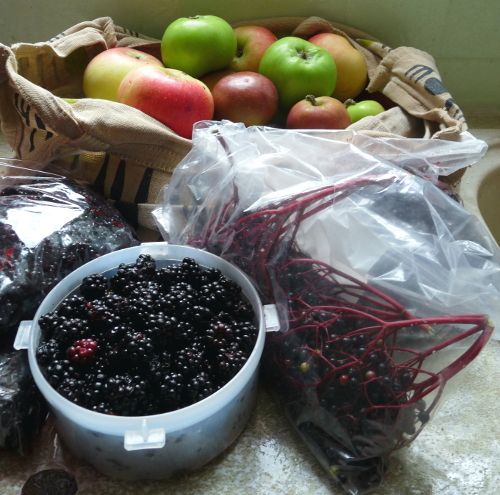
August seemed to be especially busy this year. As well as harvesting the crops from the garden, we went out foraging for blackberries, elderberries, apples and damsons. See the August harvest and foraging summary 2016 for details of what and how much we gathered.

A lot of the blackberries were eaten as we picked - they were especially sweet this year - and the rest eaten fresh with ice cream, made into a pie with some of the elderberries and damsons, and included in elderberry, damson, blackberry and apple jam.

Around half of the elderberries were made into syrup to help alleviate the symptoms of winter coughs and colds. Some of the damsons and berries were also "brandied" for Christmas liqueurs. Depending on their type and flavour the apples were eaten, added to jams and chutneys, or incorporated into fruit pies.

Our own damson tree produced some fruit for the first time. It was not a huge harvest but more than we had expected. The tree was planted about two and half years ago and the frost had burnt off much of the blossoms so we were pleased to have the handful that made it through. The variety is Merryweather and they taste more like plums than tart damsons, so they were reserved for eating "straight" rather than being made into preserves and pies as were the foraged ones.
We had our first grape harvest. There were plenty of bunches and although the fruits themselves were quite small they were very sweet. We've had plenty of advice on how to improve the yield and size of the grapes, ranging from removing some of the bunches early to reducing the number of grapes in a bunch with nail scissors. I'm not sure either of us has the patience for the latter and it seems a shame to lose entire bunches. We'll see how it goes next year but might thin out the number of grapes in just a couple of bunches to see what effect that has.

The cucumbers went berserk. I went away for a couple of days and came back to find that several monsters had materialised. Similarly, some of the courgettes both yellow and green had decided to try and imitate marrows. 
The runner beans are in full flow, the cavolo nero is doing well and we have some green peppers, which we are particularly pleased about as they are being grown outside against the south facing fence. A few of the golden beetroot were of a size that made it worthwhile pulling them up, and the tomatoes are finally ripening en masse. Our potatoes, which are grown in pots and Marshalls Gro-Sacks, are now finished. We generally had good yields and they always taste better than shop-bought so it was worth the effort. It is a shame we do not have more space that we can use for growing them. 

The most prolific of the tomatoes at the moment is a yellow/orange cherry variety. It is one of the plants that emerged from the compost that we put on the Gro-Beds and as we have not bought any seeds that fit the description it must have originally been bought from our local supermarket. I do vaguely recall buying a pack of variously coloured "speciality" tomatoes that were on the reduced price shelf. They were described as extra sweet and flavoursome but when we tried them we ranked them a big fat zero in the taste stakes. I think we put them on one side and they were eventually consigned to the compost heap. Unlike the parent fruit, the ones that have now emerged really are indeed sweet, which I can only assume is down to the growing conditions in our garden. 
Our strategy of cutting the cabbage heads and leaving the stems in the ground has paid off as we are still harvesting small heads of pointed cabbage. It will be interesting to see how long the plants keep regenerating. Kale, brussel sprout and cabbage seedlings have been potted up and are in an area next to the north facing fence that I call the brassica nursery. They will soon be planted out and so far they are looking good. The main problem is that the wood pigeons have identified our garden as a source of tasty cabbage snacks so we've had to put up some protection against the feathered varmints! 


Our sole gooseberry bush (Whinham's Industry) has settled in against the north facing fence and produced a few berries for us. It's a lovely sweet dessert gooseberry. We have taken some cuttings but have yet to decide where we shall eventually plant them.


It's not all been good news, though. The large sycamore trees that blighted our own and our neighbours' gardens have been cut down by the council but the roots are still there and very much alive. We spotted leaves sprouting from one of the roots on on our side of the fence and it was increasing in size daily. Some people recommended that we just keep cutting it back and it will eventually give up and die. But that would mean checking on the wretched thing daily and it could take years to give up the ghost. Another approach that I found on the web, and which would be especially satisfying, is to drill holes in the wood, fill them with kerosene and set fire to the whole lot. While I am sure this would be effective, it would also probably be effective in burning down several fences along with the gardens in the immediate vicinity. So we have gone for the chemical option and applied tree stump and root killer. I suspect that one treatment may not be enough and it will try and spring up elsewhere along the root or from another one, so constant vigilance will be required.

But to end on a happy note, here is a photo of part of our zone 1 alongside the kitchen and bathroom extension. Beans, tomatoes and chillis are flourishing, and the squashes are rampant and clambering up the garden wall. I may have overdone the comfrey juice! 


Thursday, 18 August 2016

July 2016 - hot!

July was an average sort of month for our area in the UK except that we had several days of very, VERY hot weather. On July 18th the temperature hit 35 degrees C. The cat gave up and tried to find somewhere cool indoors, we didn't even try to work in the garden and any watering that was needed was left to early morning. At least the spell of hot dry weather gave our squashes, peppers and tomatoes a boost, and one of the cucumber plants went berserk.

I was away working for a few days in the middle of the month and came back to a monster cucumber that had suddenly appeared alongside a couple of slightly smaller ones. It was a very nice ridge cucumber but not what I had expected. The plants that I had put in this container were supposed to be striped and globular (can't remember the name of the variety). I have no idea what went wrong with this one as the other plants are now fruiting as described on the packet. I probably mis-labelled the seedling.

The walking onions - also known as perennial onions, Egyptian onions, tree onions, or topsetting onions - are at last walking, They form a cluster of bulbils on top of a stem which makes it top heavy. The stem bends over and when the bulbils touch the ground they take root and produce more plants, so it is like they are walking across the garden. You can add the bulbils to salads or use them in cooking but this year we have reserved them for generating more onions. Nearby is a serpentine garlic, which I had completely forgotten about. Near the top of the serpentine stem bulbils are formed. When ripe, the stem uncurls and the bulbils drop to the ground, again forming new plants. Love these plants. Almost all you have to do, once they are established, is let them get on with it. Of course, you still have to thin them out and pull up the bulbs and stems that you want to eat! Otherwise, it is relax on the garden lounger with a drink and watch them do their own thing.

Egyptian walking onions
Serpentine garlic

This year has turned out to be a superb one for onions, although earlier in the year we did think that the overwintered sets were going to a disaster. A few did flower and set seed or bunch into something more akin to shallots but on the whole we have had a good crop.


The same cannot be said for the garlic. We gathered plenty of bulbs but they are all on the small side. Many of them also had bulbils forming halfway up the stems.


The veg in the containers in zone 1 alongside the kitchen/bathroom extension are doing well and an experiment in growing peas at the back of the gro-beds has been a great success. We have been having peas, peas and yet more peas for lunch! The lettuces have all been eaten and the tomatoes and squashes are now taking over the beds.

The chillis in the pots have finally sprung into action following the hot weather and it is onwards and upwards for the the runner beans. The problem with the beans is that they are so tall they are crawling across the kitchen roof. We shall either have to resort to ladders to harvest the topmost beans or leave them until the end of the season when they can be collected for seed for next year.

Peas, potatoes and cabbages are still the main crops at the moment with a few carrots and beetroot. As mentioned in the June posting the cabbages were very poor last year but have made up for it in 2016. Cauliflowers are the complete opposite. In 2015 we had several 4 pounders but this season we were lucky to have enough for a couple of meals - and the colour was weird. There is white cauliflower, cream cauliflower, green cauliflower and purple cauliflower. But we found a couple of mostly white with purple splodges caulis in our garden. It was in an area where self seeded stuff is allowed to grow so we're wondering if it's a cross between a white cauli and purple sprouting broccoli - or just a mutant! Disappointingly, the colour disappeared on cooking as is often the case with purple coloured veg.


Escaping horseradish
The bag containing the horseradish is in zone 3 and generally we don't pay much attention to it unless we want to pull up a root to make some sauce. This year we started growing strawberries for ground cover around this and other veg bags in that area and it was when we went to pick some berries that the horrible sight you see to the left greeted us. The horseradish has broken through the bottom of the veg bag, not just here but at four other points, and it is spreading. The gardening magazines, forums and blogs do warn that horseradish will eventually stage a break out no matter how well contained. This is war but it looks as though it is going to be a never-ending battle with no chance of either of us winning outright.


Mr or Mrs Toad (or both, or perhaps even the whole family) have been crawling around the garden and there are frogs a-plenty hopping everywhere. This one was spotted under the shade of the gooseberry bush. Great to see so many of them in residence.


Brassica seedlings
Everything is in place for the summer, autumn and early winter harvests but now is the time to start thinking about the mid to late winter and early spring supply of veg. We don't have to worry about the purple sprouting broccoli as we allow it to go to seed and it sorts itself out. Brussel sprouts and some cabbages are already on their way to being established as is the cavolo nero but this/next year's main project re brassicas is to try out different varieties of kale. Red Ursa on the right of the picture, a stable cross between  Frilly Siberian Kale and Red Russian Kale (seeds from the Real Seed Catalogue), leaves looks especially interesting.

With so much food coming out of the garden this month I have to show off at least one meal, which is what we had for Sunday lunch at the start of July - and we did rather pig out. NOT from the garden were rice, split peas for the dhal, chickpea flour, vegetable oil, milk for the home made yogurt, and spices. Home grown ingredients: beetroot (beetroot tikki), potatoes, peas, pea pods, cabbage, swiss chard, onion, garlic, cucumber, lettuce, coriander, parsley, mint. The bhaji (below the beetroot tikki) was made of onions, shredded pea pods and shredded cabbage.

And finally...

The view from the kitchen window, 22nd July 2016. The first crop of peas have nearly finished and now the triffids (squash) are taking over and trying to break in!


Tuesday, 9 August 2016

June - busy, busy, busy

Like 2015, 2016 started off cold and sometimes extremely wet. Everything, including parsnips, was started off indoors but May saw the start of warmer weather and planting out could begin. The good growing conditions continued in June and we had a continuing harvest of overwintered crops. We also had to play catchup over a very short time-span with sowing and planting out so there was very little time to relax and lounge around.


I started to clear and tidy up an area against the kitchen wall where, last autumn, I had dumped a couple of pots and piled up some wood. I abandoned the tidying up and replaced everything when I spotted this grumpy looking inflated toad. It could explain why the chard and brussel sprout seedlings that I had forgotten about and left out overnight had not been gobbled up by slugs and snails as they normally would have been.

I saw a second one at the other end of the garden but it could have been the same one having a wander around in search of alternative hiding places. May he/she and their friends continue their good work in the garden.


At this time of year not all the possible food growing areas are in use so if flowers pop up I leave them be. Like this poppy, they add a welcome splash of colour and encourage pollinators into the garden.

The potatoes bags right at the back of the garden are doing well and we've managed to plant runner beans against the fence itself. We still can't plant much in that strip because of  the sycamore tree roots. The trees that were on the other side of the fence have been removed but the substantial roots remain and are close to the surface. The beans do OK there but very little rain reaches them with the potatoes overshadowing the soil, so I have to remember to water them regularly.


The Babington's leeks have now reached maturity (it is their third year in the garden) and three of them have sprouted flower stalks. Hopefully they will mature and we shall have dozens of bulbils some of which will go back into the garden and the rest shared with other gardeners in the area.


Clouds of these beauties have been darting around the garden this month. Common blue damselfly Enallagma cyathigerum.


This was an experiment in growing potatoes from supermarket potatoes. It is not generally a good idea to try this as you cannot guarantee that they will be disease free and they are usually sprayed with chemicals that inhibit sprouting; but I decided to see how far I could get with some Ruby Gem. As expected, they didn't sprout very well when left on the dresser in the kitchen (my usual chitting area) but there was enough growth to encourage me to plant them out in a potato bag. Growth was rather leggy and it quickly died back. The total yield from 3 potatoes was 274g. Some supermarket salad potatoes fared even worse. They just sat on the dresser for two months and turned green.

The experiment supports the general opinion that it is not really worth trying to get a decent group out of the treated potatoes to be found on supermarket shelves.


The peas that I used to test viability and germination rates for the Reading Food Growing Network are growing apace in the bags alongside the kitchen and bathroom extension. This is what they look like from the kitchen window.


And here is the outside view. The runner beans in the tub are also starting to take off.


We have plenty of  overwintered pointed cabbages and onions this year. Last year the cabbages were a great disappointment but they have more than made up for that in 2016. I have been cutting the heads off but leaving the stems with a few of the lower leaves hoping to encourage them to regrow. We are now starting to see a second crop of looser heads of leaves.


We have a lot of wild alpine strawberries in our garden that were planted to provide ground cover at the rear of the garden while we decided what to with that patch. The area had, for the last few years, been overshadowed by sycamore trees on the other side of the fence and their roots still restrict what we can plant there. The strawberry fruits may be small but they are gorgeous little flavour bombs. Delicious with homemade yogurt and the first of this season's locally produced honey from 600 yards down the road.

The wild strawberries take over a patch of ground very quickly and are difficult to manage so regrettably they will have to go now that the ground is to be used for higher yielding crops.


Replacing the wild strawberries in some places are the larger "domesticated" varieties and the first of those are beginning to ripen.  
Two years ago I planted a small grape vine that I bought from a stall at a RISC Roof Garden open day. We may have grapes this year!


The tea bags for this year's Tea Bag Index Project have arrived. See my posting about last year's participation for details of what is involved. This year the pairs of tea bags are going into the strip of ground next to the back fence, the ground that is next to the composting area, and the narrow strip alongside the garden shed.