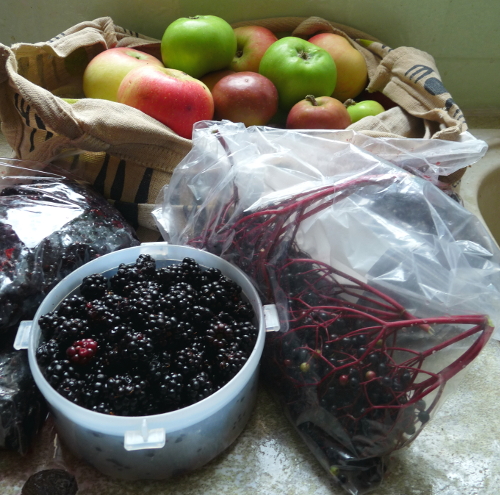
A lot of the blackberries were eaten as we picked - they were especially sweet this year - and the rest eaten fresh with ice cream, made into a pie with some of the elderberries and damsons, and included in elderberry, damson, blackberry and apple jam.
Around half of the elderberries were made into syrup to help alleviate the symptoms of winter coughs and colds. Some of the damsons and berries were also "brandied" for Christmas liqueurs. Depending on their type and flavour the apples were eaten, added to jams and chutneys, or incorporated into fruit pies.
 Our own damson tree produced some fruit for the first time. It was not a huge harvest but more than we had expected. The tree was planted about two and half years ago and the frost had burnt off much of the blossoms so we were pleased to have the handful that made it through. The variety is Merryweather and they taste more like plums than tart damsons, so they were reserved for eating "straight" rather than being made into preserves and pies as were the foraged ones.

 The cucumbers went berserk. I went away for a couple of days and came back to find that several monsters had materialised. Similarly, some of the courgettes both yellow and green had decided to try and imitate marrows.

 The runner beans are in full flow, the cavolo nero is doing well and we have some green peppers, which we are particularly pleased about as they are being grown outside against the south facing fence. A few of the golden beetroot were of a size that made it worthwhile pulling them up, and the tomatoes are finally ripening en masse. Our potatoes, which are grown in pots and Marshalls Gro-Sacks, are now finished. We generally had good yields and they always taste better than shop-bought so it was worth the effort. It is a shame we do not have more space that we can use for growing them.
 The most prolific of the tomatoes at the moment is a yellow/orange cherry variety. It is one of the plants that emerged from the compost that we put on the Gro-Beds and as we have not bought any seeds that fit the description it must have originally been bought from our local supermarket. I do vaguely recall buying a pack of variously coloured "speciality" tomatoes that were on the reduced price shelf. They were described as extra sweet and flavoursome but when we tried them we ranked them a big fat zero in the taste stakes. I think we put them on one side and they were eventually consigned to the compost heap. Unlike the parent fruit, the ones that have now emerged really are indeed sweet, which I can only assume is down to the growing conditions in our garden.
Our strategy of cutting the cabbage heads and leaving the stems in the ground has paid off as we are still harvesting small heads of pointed cabbage. It will be interesting to see how long the plants keep regenerating. Kale, brussel sprout and cabbage seedlings have been potted up and are in an area next to the north facing fence that I call the brassica nursery. They will soon be planted out and so far they are looking good. The main problem is that the wood pigeons have identified our garden as a source of tasty cabbage snacks so we've had to put up some protection against the feathered varmints!


 Our sole gooseberry bush (Whinham's Industry) has settled in against the north facing fence and produced a few berries for us. It's a lovely sweet dessert gooseberry. We have taken some cuttings but have yet to decide where we shall eventually plant them.

It's not all been good news, though. The large sycamore trees that blighted our own and our neighbours' gardens have been cut down by the council but the roots are still there and very much alive. We spotted leaves sprouting from one of the roots on on our side of the fence and it was increasing in size daily. Some people recommended that we just keep cutting it back and it will eventually give up and die. But that would mean checking on the wretched thing daily and it could take years to give up the ghost. Another approach that I found on the web, and which would be especially satisfying, is to drill holes in the wood, fill them with kerosene and set fire to the whole lot. While I am sure this would be effective, it would also probably be effective in burning down several fences along with the gardens in the immediate vicinity. So we have gone for the chemical option and applied tree stump and root killer. I suspect that one treatment may not be enough and it will try and spring up elsewhere along the root or from another one, so constant vigilance will be required.
But to end on a happy note, here is a photo of part of our zone 1 alongside the kitchen and bathroom extension. Beans, tomatoes and chillis are flourishing, and the squashes are rampant and clambering up the garden wall. I may have overdone the comfrey juice!


