Friday, 4 March 2016

Willow weaving

My own bespoke willow wigwam in situ
On Saturday, I attended a willow weaving workshop organised by and held at the Five a Day Market Garden in Englefield near Theale. I went to their Wildlife Gardening series of workshops a couple of years ago and fell in love with the place. I've been meaning to go on some of their other courses ever since but clashes with other events had prevented that until now.

We were warned to wrap up warm as most of the work would be out in the open, including harvesting the willow ourselves from the garden's own beds. So, if our creations went wonky because of our poor choice of material it was our own fault! It was interesting, though, how the type of stems - straight, slightly curved, green, yellow, red - affected the structure of our "builds". I was surprised at how much variation there was in the properties and "handleability" of the willow depending on it's colour. And, we were told, that can change from one year to the next. This variability meant that it did not matter one jot what plan we had in our heads at the start because the whole construction would take on a life of its own as soon as we started weaving. Pam Goddard, who led the workshop, very kindly called our efforts "bespoke".

Most of us decided to weave pea/bean wigwams and even with that simple basic design an amazing amount of variation, some of it unintentional, crept into our structures.


My own humble effort is now installed in the garden (see the photo at the top of this posting). It may be slightly askew but I doubt the peas will mind. 

Monday, 22 February 2016

Pea shoots

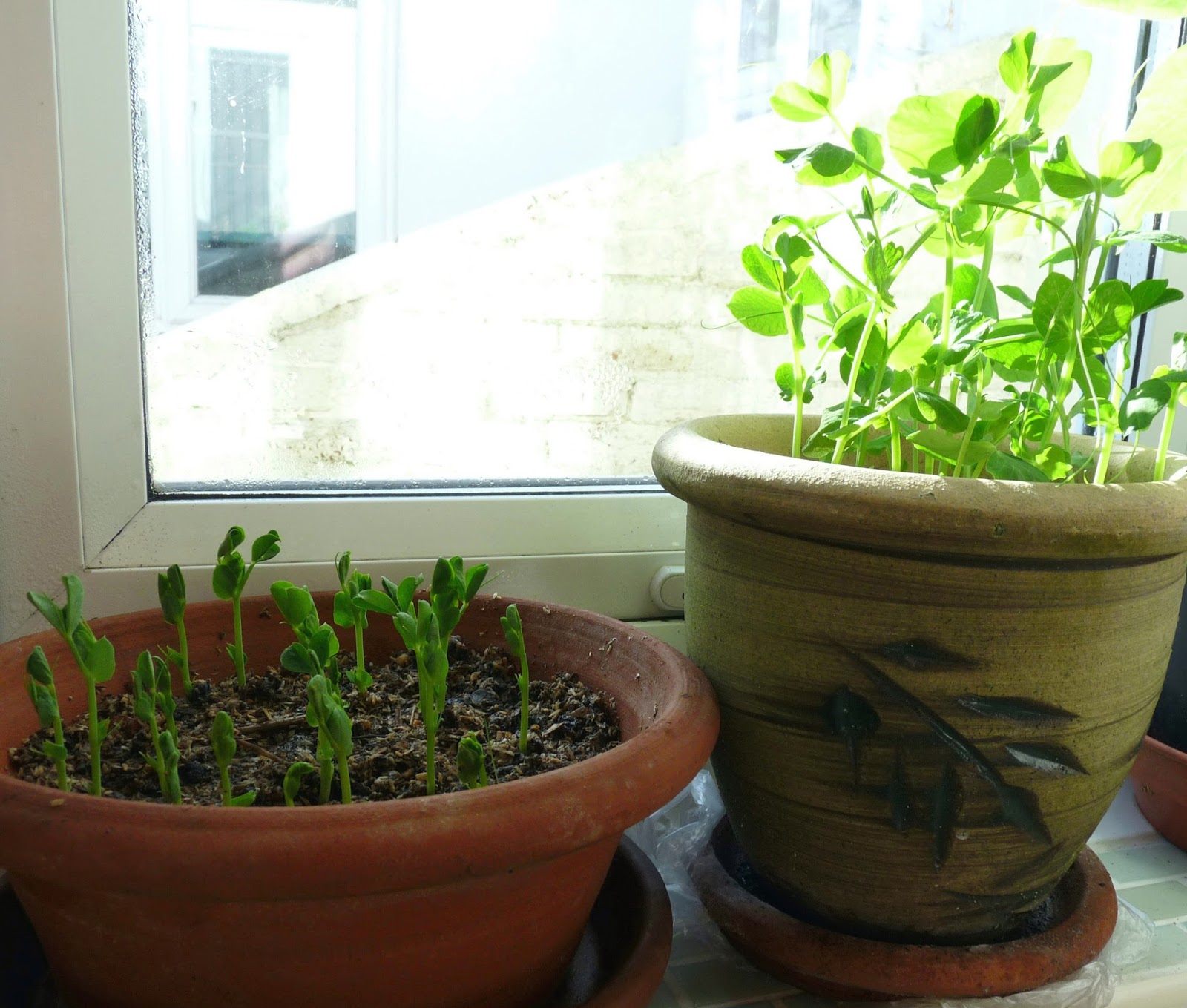
As well as the viability of the bean seeds in the Reading Food Growing Network's seed swap boxes I have been testing the pea seeds as well. Rather than throw away the germinated pea seeds - it's too cold to plant them outside at the moment - I have been putting them in pots on the window sill to grow pea shoots for food.

They are very easy and quick to grow and we've already had our first "crop". Further details on how to grow them together with a video are at How to grow pea shoots.

Our first cut yielded just 96g (3.4 oz) but enough to add to lunch as a green salad. They can be added to stir fry dishes, eaten raw, used in sandwiches instead of lettuce or cress, and included in risottos. We'll see how many cuts we get from each pot but it seems that most people manage to do two or three before the shoots become too stringy and lose taste.


So our lunch consisted of vegetable biryani (parsnip, squash. swiss chard, onion, garlic), dhal, homemade yogurt with spring onions and garlic, and pea shoots.

Friday, 19 February 2016

Checking our preserves reserves


As part of the early spring cleaning in the kitchen I usually check what chutneys and preserves we have in the cupboard. It gives me a chance to see what we have left and to move older jars to the front of the shelves for immediate consumption. This year we are doing rather well, although we are getting through the four fruit marmalade I made from oranges, lemon, lime and grapefruit in January this year. 

From 2015 we still have: 


From 2014 I discovered lurking at the back of the cupboard:

  • Rowan, rose hip, hawthorn and apple jelly 
  • Spiced blackberry and apple jam
  • Spiced damson chutney - 2014 was a bumper year for damsons, which was just as well as 2015 was rather disappointing. 
Supplies should last until production starts again later this year! 

Saturday, 6 February 2016

My Babington's leeks are very determined perennials

Earlier this week I checked the clumps of Babington's leeks that are dotted around the garden. This is their second year so I was hoping that some might be ready for eating. When I planted them out I wasn't sure how many would grow to maturity and I didn't leave that much space between them. They've all done very well and as a result are suffering a bit from overcrowding. No problem, I thought, just pull a few of them up. I thought they would come out easily, like garlic. Far from it.


Although I had originally planted them about an inch and a half below ground, I didn't realise that they have what are called contractile roots that enable them to bury themselves deeper into the earth. I pulled some of the stems expecting to extract the whole plant but the stems snapped off leaving the bulbs about 6 inches down. To get the whole thing out I had to remove all of the soil above and around the bulb. Even then they did not want to come out. I suspect they are going to be a bit like horseradish; once they are established you can't get rid of them.

I managed to harvest enough plants to yield about 200g of edible leaves, stems and bulbs. They are delicious chopped and stir fried, and taste like garlicky leeks. A worthwhile addition to the garden but, if you are going to try them yourself, be careful where you plant them. They will strongly resist attempts to move them if you later decide they are in the wrong place!


Wednesday, 20 January 2016

Bean experiment

Yes, I know, it is way too early to start growing beans in the UK. I have been testing the viability of seeds in the Reading Food Growing Network's seed swap boxes. It seemed such a shame to waste the bean seeds that germinated so I decided to "pot" them up. And, yes, those are toilet roll cardboard inners. 

I'm not sure where this experiment is going but the main problem that I can see is one of pollination - if I manage to keep them growing indoors. Planting them outside is a non-starter for a few months.

I'll post updates on the progress or failure/death of the experiment!

Update August 2016: Although they started off well and growth was steady, when it came to setting "fruit" the experiment was a disaster. They plants were potted on and kept indoors so there were no insects to pollinate them and my attempts to mimic the process using a tiny paintbrush were a total failure.  

Friday, 8 January 2016

Lunch: an eclectic mix of flavours and ingredients

Today's lunch - usually our main meal when we are working at home - was an interesting mix of flavours and ingredients. Some came straight from the garden, some were dried or preserved garden produce and some shop bought.

So, starting at the top of the plate and moving clockwise, here is what we had.

Injera style sourdough flat breads (rye and spelt flour)

Red cabbage (bought at the local farmers' market) with fennel seeds (garden)

Various beans (some garden) with homemade tomato sauce (made a couple of months ago from garden tomatoes), onions (garden), garlic (garden), dried herbs (garden).

Green and puy lentils, swiss chard (garden), shallots (garden), garlic (garden), ginger and spiced with garam masala.

Home made, oven baked onion bhajis (onions from the garden).

Raita made with home-made yoghurt but shop bought, out of season cucumber [Gasp,  shock, horror!]

Sprinkling of coriander leaves (pot on window sill)


Friday, 1 January 2016

Good crop of hairy bittercress in the garden

With the weather having been so mild this December we have an abundant crop of hairy bittercress (Cardamine hirsuta) in the garden.

As well as providing ground cover this member of the mustard family is also edible and has a peppery taste. Add it to soups, salad, pesto, salsa and use instead of cress in sandwiches.


Further information on this wonderful "weed" at

Forage Wild edibles- Hairy Bittercress Food foraging guide

Hunter-Gathering: wild & fresh food - Hairy Bittercress Pesto

Hairy Bittercress, Cardamine hirsuta