
Sunday, 20 September 2015
Harlequin squash
I'm new to this squash growing lark but suspect that I ought to this harlequin squash soonish. It was one of the plants that popped up out of the compost I spread across the garden at the start of the year, I recall buying a squash similar to this from the True Food Co-op in Emmer Green and I would have put the seeds and skin into the compost, so that is where this one has come from.


Cyclamen
It's September and clumps of cyclamen are now flowering and adding splashes of gorgeous colour to the shady borders. And the wonderful thing about them is that once they are established they come out year after year, so no work is involved other than thinning them out.


Tuesday, 15 September 2015
Harvests page
Several of us thought it would be a could idea to keep a record of what we actually harvest from our gardens and make notes on the quality of the veg. So I am keeping a separate record on a Harvests page at http://cavershamgarden.blogspot.co.uk/p/harvest.html. We are two thirds of the way through the growing season but we have to start somewhere. The list will be continually updated with the most added to the top.
Wednesday, 12 August 2015
Tea Bag Index (TBI) UK

We each receive three pairs of tea bags (one green tea and one rooibos) and bury each pair in different parts of the garden. After three months we dig them up and send them back to Sarah for analysis with soil samples and a completed questionnaire. More information about the project is at http://teabagindexuk.wordpress.com/.
 Suggested places to bury them are the lawn, a spot that has been treated with organic matter and an area that you are particularly interested in investigating, for example a bare patch or an area that is often waterlogged. We are allowed to choose other spots but the important thing is to fill in the details on the questionnaire of the location and whether fertilisers, pesticides or herbicides have been or are used.
The lawn was not an option for me. We do have a small patch of grass but the tea bags have to be buried about 3 inches deep and at 1.5 inches under our lawn you hit builders rubble! So, I decided to put the first pair in the middle of my herb patch. I don't add any compost or fertiliser to this area other than some leaves from the comfrey plant that is growing there.
The second pair went into an area close to the compost heap that is regularly fed garden compost and is used for growing brassicas and squash. I buried the third pair in a small patch of ground in front of the house. It is a bit of a problem area in that it gets full sun during the day and dries out very quickly. I've not had much luck growing anything in it apart from a few wild flowers, bulbs, rosemary, onions and masses of rudbeckia.
So now we just sit back and wait for three months.
Sunday, 26 July 2015
Squashes popping up everywhere


This squash came from a friend who said it was either a butternut or a dumpling squash (they'd lost the label). It doesn't look like either of those and is fast growing into what appears to be a marrow. It is now close to needing a sling to support it.

This is another one that popped out of the compost. This one could possibly be an acorn or a harlequin squash.
And there are a lot more dotted around the garden including a definite butternut squash.
Friday, 24 July 2015
Don't panic! Don't panic!

A full Smith Period has occurred when at least two consecutive days have had min temperatures of 10ºC or above and on each day at least 11 hours when the relative humidity has been greater than 90%. A 'near miss' occurs when one or both of the above two consecutive days has only 10 hours when the relative humidity is greater than 90% and the temperature is 10ºC or above. Of course, microclimates in the garden will also come into play and I find that going into the garden a couple of times a day to get a feel for the temperature and, more importantly, the humidity is a better guide to when conditions make blight more likely to occur.
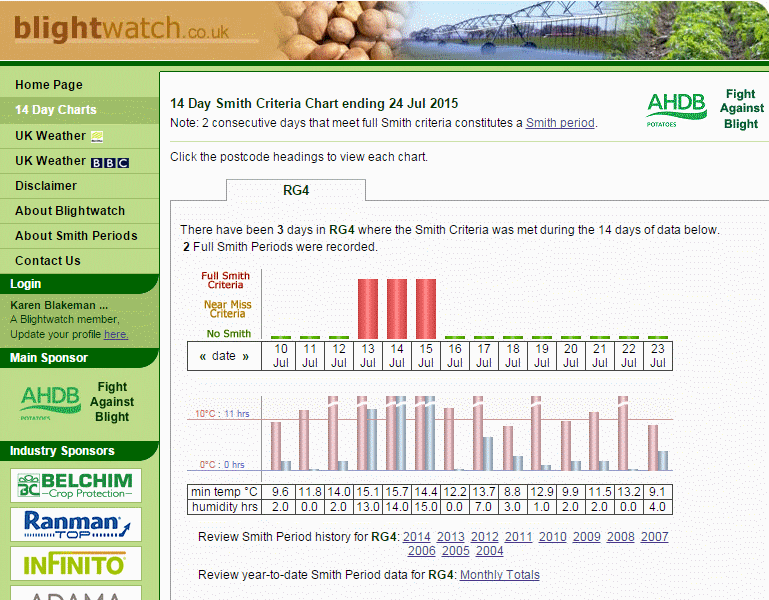 |
| Full Smith Period alert for RG4 |
Blightwatch.co.uk is run by the Potato Council's Fight Against Blight. To receive alerts of full Smith Periods you first have to register (free of charge) and then give it the first part of the postcode you want monitored. You can receive alerts by email or by SMS and view the charts online.
When it comes to treating plants, by the time the symptoms of blight have appeared it is usually too late to do anything. Most of the chemicals that have been used in the past to prevent blight have been withdrawn from sale to home gardeners in Europe but it has been suggested that aspirin may help protect plants (Trouble in the vegetable patch? Break out the aspirin). Prevention remains the best strategy. See Identify, prevent and treat Tomato Blight in the UK
Saturday, 18 July 2015
Blackfly!
 |
| Blackfly on a courgette |
The veg gardening is flourishing and so are the aphids, and in particular the blackfly. I haven't been too badly hit - only a couple of beans and a courgette - but some of my friends have reported a total infestation plus a noticeable absence of ladybird larvae that usual chomp up all the little blighters. A couple of people have reported that the ladybirds have started to appear but too late frown emoticon
I sprayed the beans with water from the kitchen washing up bowl and the courgette is thriving left to its own devices, although the infestation isn't that bad.
Are others in the UK, and especially Reading, suffering as well and how do you manage the problem?
Subscribe to:
Posts (Atom)